Are We Giving Up Driving One Feature at a Time?
Weekly Wheaties #2543
In this newsletter:
📝 Post: Are We Giving Up Driving One Feature at a Time?
🗞️ In Case You Missed It: AI Browser Wars
🗞️ In Case You Missed It: Internet Outage
😎 Pick of the Week: Halloween Travel
📦 Featured Product: LED Flashlights
📝 Are We Giving Up Driving One Feature at a Time?
As we’ve seen technology integrate deeper and deeper into our lives and products we use and purchase, I’d like to start this post with a thought experiment.
Would you rather never drive again, or never have any form of driver assistance?
Essentially, I’m asking if you would only want all autonomous vehicles on the roadways, or none. Except, autonomous vehicles may also include those with driver assistance features, including cruise control and power steering - basic features included in just about every vehicle we have come to take advantage of. Even newer vehicles have more advanced features like Adaptive Cruise Control (ACC), Lane Keep Assist (LKA), and Automatic Emergency Braking (AEB).
One of the questions that arises is in this gray area between autonomous features and fully autonomous driving. To be clear, full autonomy is *possible, but not legalized except in a few pockets across the US (Austin, Las Vegas, and San Francisco, for example). This “misunderstood middle” is explained in depth by a friend of mine in his dissertation, The Misunderstood Middle: Assessing Driver Acceptance and Perception of SAE Level 2 Advanced Driver Assistance Systems. Essentially, he emphasizes “the importance of transparent communication about the capabilities and limitations of semi-automated driver assistance systems.”
There is a lot of confusion among most drivers about what Tesla’s Autopilot and what GM’s Super Cruise modes actually do. Spoiler: they do not autonomously drive for you. However, they do provide a level of driver assistance of steering, acceleration, and braking, that wasn’t available until recent years. There are a lot of questions around legality, ability, safety, and much more. I don’t want to dive too deep there, as I have before.
The next question becomes - where do we go from here?
I’d like to use the History of Central Park to explain some future potential options. And to be very clear. These are only my opinions of possible options. I am not making any statements of fact or opinion here.
When first created in the mid to late 1500s, Central Park was a place where those living the bustling city life could escape nearby and enjoy the peace and serenity of wildlife and nature, mirroring what was available to their European counterparts. However, what’s interesting (at least from a design standpoint), all roadways for the various activities never (or at least rarely) intersected. Meaning, vehicles, pedestrians, horses, and carriages could all traverse the park without interacting with one another.
As time went on and vehicles took over the road, while horse and carriages were all but banished. Central Park became a place for even more ‘escape’ from the city, allowing those with horses to have a place to ride. This also allowed horses more of a ‘right of way’ in Central Park, requiring pedestrians, bicyclists, and other enthusiasts to give way to a horse and/or carriage.
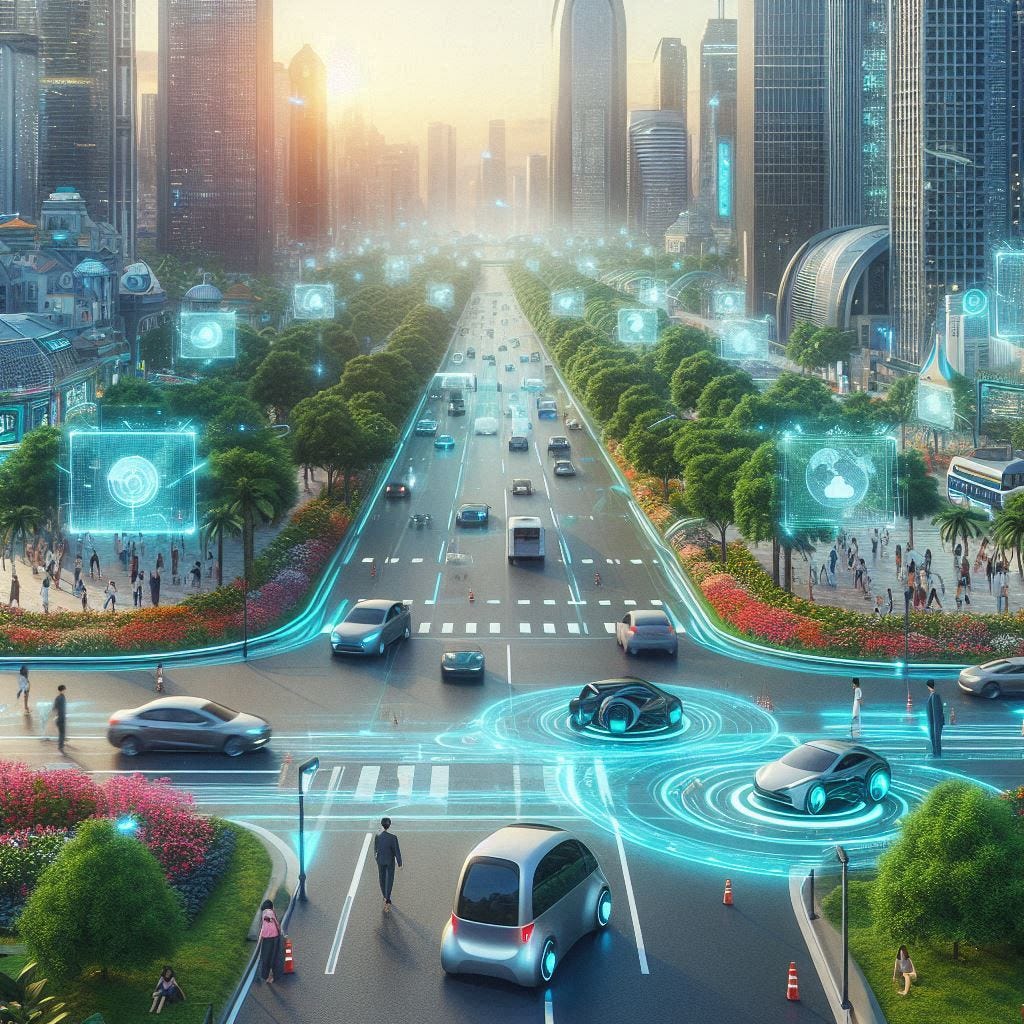
With the autonomous vehicle boom (can I call it that?), we are moving towards something similar. I believe that as more and more autonomous vehicles are taking over the roads, there will be a few things that happen in order. I have no idea of the timing, nor am I talking about electric vehicles.
First, there will be a requirement for all vehicles sold after [some date] to include autonomous features — at minimum, ACC, LKA, AEB, and something not mentioned yet - a chip to allow the vehicle to ‘connect’ to other vehicles and/or the grid. This is known as Vehicle to Everything, and allows your vehicle to talk to other vehicles, Bluetooth signals, traffic signals, and tons of other sensors your car comes in contact with every day on many (if not all) of the roads you traverse every day.
Second, on major highways (i.e., interstate systems), there will be a new lane open (or a current lane converted from HOV) for only vehicles in the “Autonomous Mode” that meet the hardware requirements as mentioned above. In this lane, no human interaction will be allowed, as all vehicles will drive themselves while communicating with each other and the grid, to flow as fast and safely as possible. Crashes will all be non-existent, and travel times will improve significantly. At least over time.
Third, these major highways will then convert all lanes to the same requirements.
Fourth, more major arterial roadways will then convert to the same requirements.
The kicker, though, is that there will have to be major legislation passed for step three and beyond. Which will (and should) be difficult. This is a major change of public access, and whatever is done, the public should be allowed to commute and travel in freedom, at least within the law. Again, for timing, I don’t know if this will happen in the next 10 or 100 years, just sharing what I think is possible and probable.
But if you take this thought experiment further, the thought is that at some point in the future, autonomous vehicles will not be allowed on the roadways. There will be a new market for joyriding in non-autonomous vehicles. I’m not talking about offroad racing, either. I’m talking about roadways like Route 66, Highway 1, and Highway 129, not allowing autonomous vehicles, but also requiring an ‘old-school’ driver’s license to traverse.
The final question of this thought experiment may be a question we can’t really decide how we answer - In the future, will we even be able to drive at all?
🗞️ ICYMI: AI Browser Wars
Assuming you browse the internet in some way, chances are you’re using one of the two largest web browsers - Google Chrome or Microsoft Edge. Over the last few months, Chrome and Edge have seen a lot of updates to help integrate AI as best they can. For help on what’s possible, Go behind the browser with Chrome’s new AI features, or Meet Copilot Mode in Edge: Your AI browser. We’ve seen Microsoft’s investment in OpenAI, but Google also doesn’t want to fall behind, as they and Anthropic announce a cloud deal worth tens of billions of dollars.
All that said, there’s a new big player in the game — Introducing ChatGPT Atlas. This browser appears to be a Chromium browser powered by ChatGPT, as it starts with a chat screen as opposed to search (or news). There are a lot of specific use cases and settings I haven’t even been able to test out yet. But if this is something that sounds interesting, no harm in checking it out. However, it does require a Mac, and although I can’t verify, I would assume it works best with a paid ChatGPT account.
🗞️ ICYMI: Internet Outage
Early last week, we saw AWS services recover after a day-long outage hit major sites. AWS (or Amazon Web Services) is essentially a backbone cloud storage offering for many of the websites and apps you frequent on the web. Every website or app must have some sort of cloud storage in order to ‘host’ their files and information. This can be done locally, but is not generally suggested due to costs and upkeep. Another alternative to AWS includes Microsoft Azure, or other services offered through Oracle, Google, and IBM, among others. This goes to show that a small set of downtime on any major pocket of the internet has major and lasting effects that will only become greater, but also more stable as the network expands.
What caused this outage is another question in and of itself. Typically, updates and/or modifications to the codebase can cause hiccups. However, Amazon Allegedly Replaced 40% of AWS DevOps Workers With AI Days Before Crash, so many are thinking AI updates are what may have caused it. We may receive more information in the coming days or weeks, but remember, Amazon Plans to Replace More Than Half a Million Jobs With Robots, so this probably won’t be a one-time issue.
Another piece to web services, with a mixture of the AI flair, includes Cloudflare. At a very basic level, they offer services that act as an intermediary network between your networks and the networks where the websites and apps you are trying to access are located. Here, they are able to intercept security issues on both sides while speeding up the network traffic for all users. Now, Cloudflare wants Google to change its AI search crawling. Google likely won’t. They have updated their “rules” for a Robot.txt file, helping sites dictate if their website can be used to scrape for search, used for helping answer AI chatbot requests, or to help train the AI models moving forward.
😎 POTW: Halloween Travel
If the parties, candy, and trick or treating aren’t enough, perhaps a trip to visit some places argued to be haunted? Or at least mysterious enough to have some great stories to go along with.
📦 Featured Product
I know there are tons of flashlights to choose from. Especially the larger brand-name guys. However, I have two of these no-name LED Rechargeable Flashlights that are incredible. To be clear, the ones I have aren’t this exact model, but it’s very similar. They have a beam that jokingly can ‘see the heavens’ at night, but can also be so wide you can almost see your whole yard. They are rechargeable via USB-C, and if they stop charging, double-check the wiring - an unnamed person in my home may have dropped mine, and the wiring disconnected. A quick solder, and it was good to go again. If you would prefer something name-brand, I also have a Goal Zero Torch for over 10 years. It has great battery life along with a super bright flashlight. I specifically have the Torch 250 that comes with solar charging, along with a USB port to charge your phone or other device if in a pinch. However, it doesn’t seem to be manufactured anymore in place of the Lighthouse Core Lantern.


