

In this newsletter:
📝 Post: Is EV Charging Really as Slow as You Think?
🗞️ In Case You Missed It: YouTube TV and Disney
🗞️ In Case You Missed It: Tech Headlines
😎 Pick of the Week: Furniture and Design Picks
📦 Featured Product: HDMI 4 in 1 Switcher
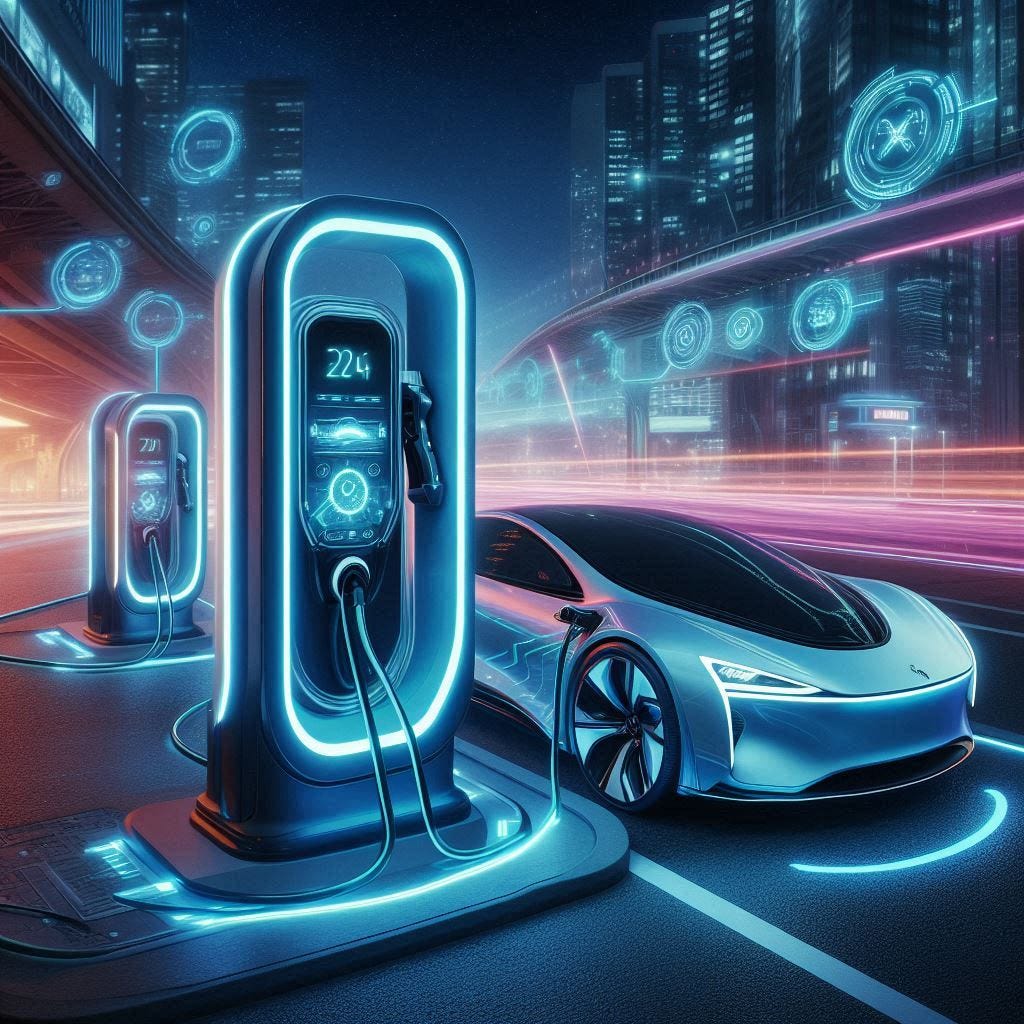
📝 Is EV Charging Really as Slow as You Think?
Believe it or not, I’ve had a couple of friends and a family member recently purchase an electric vehicle (EV) without my direct involvement - or at least what some may call my ‘strategic convincing.’ As much of a proponent of EVs as I am, at least for where they make sense, I am more of a fan of Tesla in general in regard to it being “the coolest computer on wheels” (my words).
As alluded to, I am a big proponent of only buying an EV when it makes sense for you and your specific situation. If you have a typical job with a standard commute, say less than 150 miles round trip, EVs can be a great value if comparing cost per mile with gas and maintenance. If you drive further than that, or want to use it for your vacations or trips further than the maximum range of your EV’s battery, you’d be required to stop and charge on your way.
Charging an EV is almost a science in comparison to filling your car up with fuel. For starters, you have to plan a trip out better simply because there are not as many chargers available as gas stations. Tesla is by far leading the way on the private side of things with “over 70,000 Superchargers globally.” Check out this map to see where they are located. Another map that is useful (and sometimes easier to use) for Tesla Supercharges is Supercharged! It is available on Apple’s App Store or the Google Play Store. For other non-Tesla charging stations, the most popular app/program is ChargePoint. They also have an iOS and Android app, as well as integrate well with Apple and Android CarPlay.
However, another major difference between gas pumps and electric charging has to do with the flow of your ‘fuel.’ My anecdotal research of using gas pumps over the last 30ish years tells me that 99% of them flow about the same speed. Of course, every once in a while, one takes forever, but for the most part, all consumer vehicles can have their tanks full in less than 5 minutes. So why does it take an EV so long?
Well, arguably, an EV doesn’t take as long in comparison as you may think. But I would like to share what properties dictate how fast an EV can charge. We’ll break these down a bit more, but here are the following things that affect your charging speeds:
Size of your vehicle’s battery and type of charging capability
Current battery percent
Planned charging percent/distance to next stop
Charging station status and capabilities
Preconditioning ability
Weather demographics
Your vehicle’s battery is typically measured in kilowatts (kW), and the total size may range from as little as 50 kW with maybe 100 miles of range up to over 200 kW and a range approaching 500 miles. Typical ranges are a bit below and around 100 kW for vehicles with a range of 200-300 miles.
When stopping to charge, the batteries typically charge the fastest if around or lower than 20%. And once they reach 80%, charging slows down dramatically. For this reason alone, it benefits vehicles when traveling to never charge above 80%, which is counterintuitive to filling up a gas tank. Stopping to charge twice for a shorter amount of time (going from 20-70% twice rather than 0-100% once) is generally much quicker in overall time. Many other times, you may only want to charge enough to get to the next charger within a given charge range rather than take time charging. This also assumes you are stopping multiple times. Distance traveling vs time traveling are two big factors here.
Another app, A Better Routeplanner, allows you to pre-plan any of your trips by entering your start and end point, input your exact car make and model, and choose between one of the following: Few but long stops, Quickest arrival, or Short but many stops. This ‘plan’ will tell you when and where to stop and for how long. You can add multiple stops, too.
In most of the apps mentioned, they also show the charging station’s status and capabilities. Many have multiple charging stations, and the more people charging at the same time may affect the total charging speed. However, a bigger issue is the charging speed the station is capable of. For example, a Level 1 charger is your basic 120v plug in your home. These charge around 1kW (or 3-5 miles of range) per hour. A 240v plug (similar to your stove or dryer) will charge closer to 8 kW (or ~30 miles of range) per hour.
Tesla (and other brands) have DC Fast, Ultra-Fast, and Extreme ‘Superchargers.’ These are as low as 50 kW (but are typically 150 kW), and newer ones are around 350 kW, if not more. These are the types of chargers that allow 20-80% battery charging to happen in 10-20 minutes.
The last two properties kind of go hand-in-hand. The external weather conditions (typically just temperature) affect how fast your battery can accept a charge. Some vehicles have a setting known as Preconditioning that will warm or cool the battery before reaching the charging station to allow optimal charging. For example, if it’s really hot outside and you’ve been driving for a while, your battery is probably pretty hot. By allowing the car to precondition the battery and cool it down, it will charge much faster than if not.
Ultimately, there are too many factors that affect your EV’s battery charging status for comparison to be made to a typical gas-powered vehicle. In general, it’s safe to say it doesn’t take as long to charge as one might think, especially if planning for and considering the total trip time. Not to mention, if only using an EV for your daily commute and you have a Level 2 charger at home, you may never even need a Supercharger.
🗞️ ICYMI: YouTube TV and Disney
In the cordcutting/streaming space, Google offers a ‘cable-alternative’ called YouTube TV. But this should not be confused with the website and social media platform YouTube.com. At $83/month, it offers an ever-growing library of “Top Channels” from most major news, entertainment, and sports networks. Of those networks, there has been a monetary discrepancy between them and the Disney-run channels (including: ABC, ESPN, FX, Nat Geo, and more). Disney asked to have ABC restored for the election, to which they responded with a Blog post. YouTube essentially denied the request and asked to restore the original deal. Disney responded internally with a memo that reflects pessimism.
🗞️ ICYMI: Tech Headlines
Apple Nears $1 Billion-a Year Deal to Use Google AI for Siri
Meta reportedly projected 10% of 2024 sales came from scam, fraud ads
OpenAI, Walmart Partners to Create AI-First Shopping Experiences
Tesla Shareholders Approve Elon Musk’s $1 Trillion Pay Package
😎 POTW: Furniture and Design Picks
We’re always hit with a ton of ads, but sometimes they just get it right. I happened to be served an ad to “experience unparalleled sophistication and masterful artistry” from Sohnne Designer Furniture. I didn’t buy anything yet, but I absolutely saved the link for future me!
I’m sure most of us have heard of Ikea before, but you may have missed their Ikea Phone Sleep Collection. While originally thought of as a joke, this is a real product, but it can only be purchased in the UAE.
A TikTok featuring Waterbed Services Reaches 6.5 Million Views (and counting). Just in case you were wondering if people still bought them. Apparently, they are still around and have had a few updates over the years, too. Check out the Alternative Bedding Waterbed Services Co. in Pittsburgh, PA, and watch the video on their site in case you missed it.
Lastly, check out 30 Of The Most Impressive Architectural Ideas Inspired By Simple Everyday Objects.
📦 Featured Product
With college and NFL in full swing, I’m assuming there’s been a day or two you wanted to stream multiple games, and you may not have access to the Red Zone. Or you’d like to pick your own games. Or maybe you’d also like to stream Bluey, follow the weather, or play an Xbox game? Some TVs still allow PiP, but even better, you could consider the OREI HDMI 4 in 1 Switcher. This box allows you to connect four different HDMI sources. This could be a mix of a streaming box/stick or 4, a gaming console, a tablet or computer, or literally anything else with an HDMI output. It then has 1 HDMI output source to feed all of these into a 2x2 or 1x3 view of each source on one TV. Think of this as your own personal PiP setup!
